
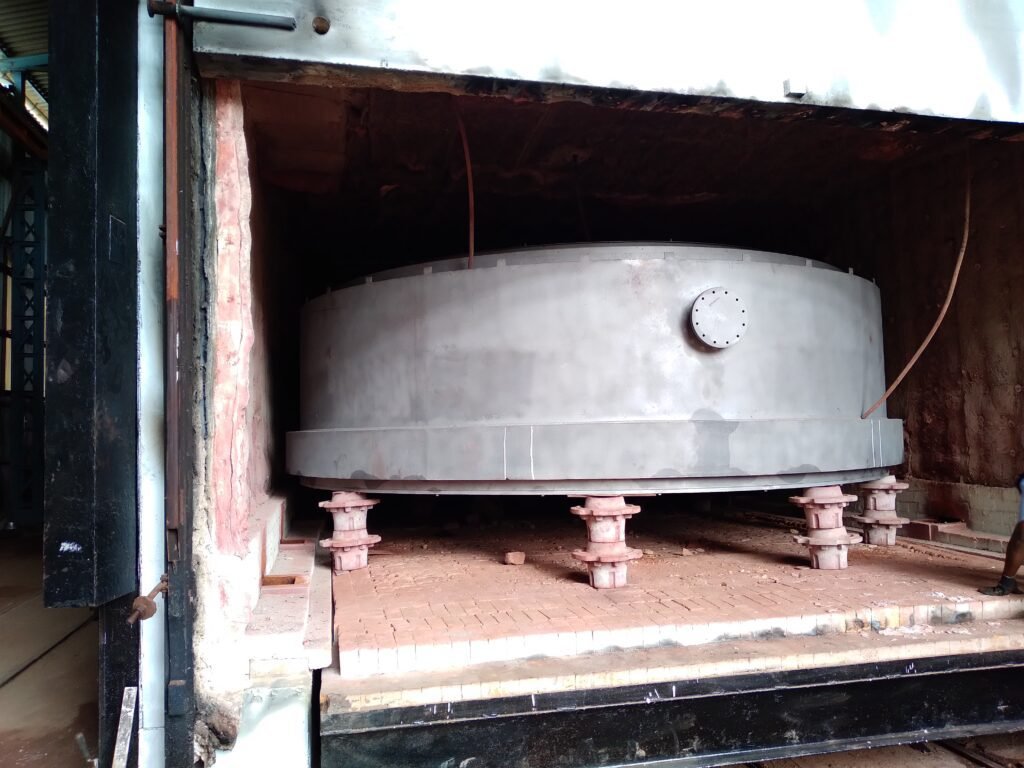
Stress Relieving for critical industrial components in Chennai.
Stress relieving heats a fabricated component to below its critical temperature, holds it at a controlled soak, then cools it slowly to release the residual stresses locked in by welding, casting, forging, and machining. We run the process in calibrated bogie-hearth furnaces with monitored heating and cooling rates, so large fabrications come out dimensionally stable and ready for service or final machining.
Typical Applications
- Welded boiler drums and pressure parts
- Sector plates and steel rollers
- Turbine casings, stators, and rotors for windmills
- Heat exchangers, impellers, and dished ends
- Flanges and aerospace components
- Railway brakes and side frames
Why Stress Relieving Matters
Reduced distortion
Relieving locked-in stress keeps welded and machined parts dimensionally stable in service.
Longer component life
Lower residual stress means less risk of cracking and fatigue failure under load.
Machining stability
Parts hold tolerance through subsequent machining instead of moving after the cut.
The Heat-Treatment Cycle
A schematic of the stress relieving cycle: a controlled ramp to temperature, a soak to equalise the section, then the cooling stage that defines the result.
Slow, controlled cool below the critical temperature.